
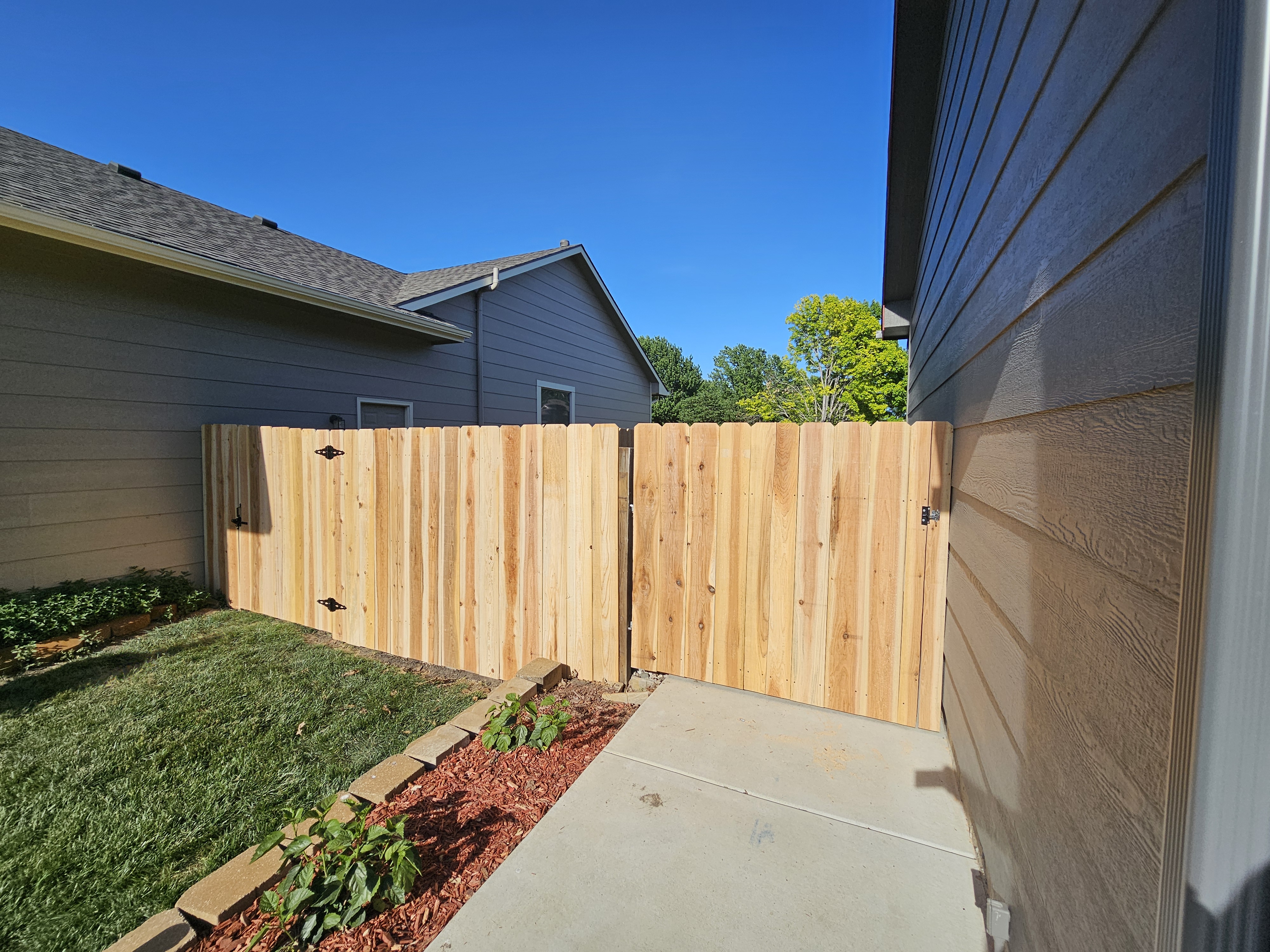
If you own a home in south-central Kansas, you already know the wind is not a rumor. Wichita averages sustained winds that rank among the highest of any major U.S. city, and spring and summer gusts regularly clear 40–50 mph. That wind is the single biggest reason fences here lean, rattle loose, or blow flat — and it's exactly why the fence that works great in a calm climate can fail within a few seasons in Bel Aire, Derby, or Andover.
The good news: a fence built for wind isn't more expensive to own — it's cheaper, because you're not repairing or replacing it every few years. This guide walks through the styles, materials, and installation details that actually matter when the gusts pick up, so you can make a confident choice for your property.
Why Kansas wind breaks fences
A privacy fence is essentially a large sail. When wind hits a solid panel, that force has to go somewhere — into the pickets, the rails, the posts, and finally the ground holding those posts in place. Fences fail at whichever link is weakest. In our experience the usual culprits are shallow or under-set posts, panels with no airflow, and hardware that was never rated for repeated stress.
The most wind-resistant fence styles
Style matters as much as material. If privacy is your priority but wind is a concern, these designs hold up best:
- Shadowbox (board-on-board with gaps): alternating pickets on each side let air pass through while still blocking the view. It looks finished from both sides and dramatically reduces wind load.
- Spaced-picket privacy: a small, deliberate gap between pickets bleeds off pressure without sacrificing much privacy.
- Ornamental iron and aluminum: open pickets barely catch the wind at all, making them nearly bulletproof in gusts — ideal for pool enclosures, garden borders, and front-yard accents.
- Chain link: not private, but the open mesh is one of the most wind-tolerant options available and a smart pick for large perimeters and commercial lots.
A fully solid, edge-to-edge privacy fence can absolutely work in Kansas — it just has to be engineered and installed for the load, not thrown up with pre-made panels.
Material choice: wood vs. vinyl vs. metal
Every material can be built to survive wind, but each behaves differently:
- Wood (cedar or treated pine): stick-built on-site, wood lets us tune picket spacing and rail count to your exposure. Western Red Cedar resists warping and looks classic; treated pine is the cost-effective workhorse.
- Vinyl: maintenance-free and clean, but quality varies wildly. Wind-rated vinyl uses thicker walls and internally reinforced (often aluminum-inserted) rails — cheap hollow vinyl is the stuff you see folded over after a storm.
- Ornamental metal: the most wind-tolerant and longest-lasting, with clear sightlines. Best where you want security and elegance more than full privacy.
The detail that matters most: how the posts go in
Here's the part most homeowners never hear about — and it's the single biggest predictor of whether a fence survives Kansas wind. The posts are the anchor for the entire structure, and how they're set decides everything.
We post-drive our fences, mechanically driving each heavy-duty post 30–36 inches into undisturbed, compacted soil. Undisturbed ground grips a post far more tightly than a hole that was dug oversize and backfilled with concrete, which can crack, heave with the freeze-thaw cycle, or work loose over time. Post-driving also means no messy concrete pours and a cleaner job site. Pair deep-set posts with properly spaced rails and reinforced, sag-resistant gates, and you have a fence built to shrug off the gusts.
Quick checklist before you sign a fence contract
- Ask how deep the posts are set and whether they are driven or concreted — and why.
- Confirm the pickets, rails, and hardware are rated for wind, not just the cheapest available.
- Make sure gates use internal anti-sag frames and self-closing, heavy-duty hardware.
- Verify the installer is licensed and insured and handles locates and permits.
- Choose a style matched to your exposure — more open designs for the windiest lots.
Build it once, build it right
As a Majority Veteran-Owned, fully licensed and insured team, Apache Fence & Outdoor Living builds every fence to handle the weather it actually has to live in. We install wood, vinyl, chain link, and ornamental iron fencing across Bel Aire, KS and the greater Wichita area, and we back every project with a thorough final walkthrough. If you're weighing your options, we're happy to walk your property and give you a straight answer about what will last.
Frequently Asked Questions
What is the most wind-resistant fence for Kansas?
Open styles like ornamental iron, aluminum, and chain link handle wind best because they let air pass through. For privacy with wind resistance, a shadowbox (board-on-board) or spaced-picket design paired with deep, post-driven posts is the strongest practical choice.
How deep should fence posts be set in Kansas?
We drive heavy-duty posts 30–36 inches into undisturbed, compacted soil. Deep-set, post-driven posts anchor far more securely against high wind than shallow holes backfilled with concrete, which can heave or crack with the freeze-thaw cycle.
Is vinyl fencing strong enough for Kansas wind?
Quality vinyl can be, but it has to be wind-rated with thick walls and reinforced rails. Thin, hollow vinyl fails in storms. If you choose vinyl, insist on a reinforced product and properly anchored posts.
Do you need a permit to build a fence in the Wichita area?
Many local municipalities require a permit and setback compliance for fences, and rules vary by city and HOA. We handle utility locates and pull the necessary permits as part of our fence installation service so your project is code-compliant.
Ready to Build It Right?
Veteran-owned, licensed, and insured. Reach out for a free consultation and estimate across Bel Aire, KS and the greater Wichita area.